Advanced Characterization, Simulation and
Troubleshooting of Electronic Power Systems
April 29th
The OMICRON Lab Power Analysis & Design Symposium is an annual event focusing on advanced characterization, simulation, and troubleshooting of board-level power-electronic systems. International experts from the field include practical examples and demonstrations in their lectures.
The 15th Power Analysis & Design Symposium will take place as a live, virtual event on Wednesday, April 29th, 2026.
Experience a great day packed with live lectures from international electronics experts focusing on power supply design.
Seminar Topics
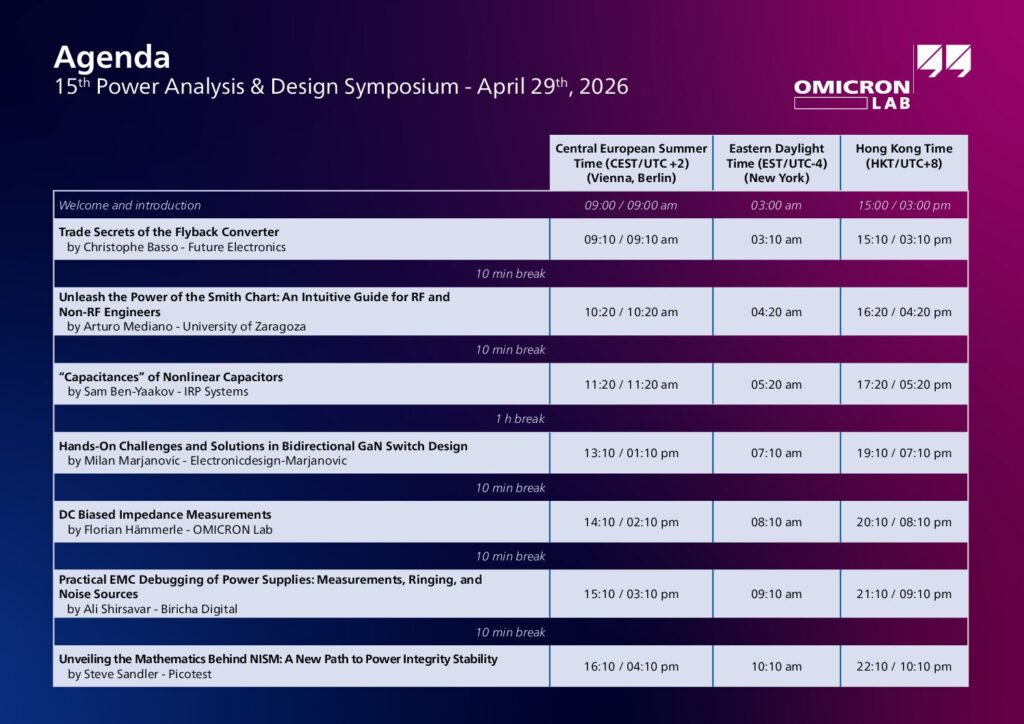
Trade Secrets of the Flyback Converter
by Christophe Basso – Future Electronics
This new seminar goes into less documented details of the flyback converter, covering control and effects of the leakage inductance on cross-regulation. Current-mode instabilities are explored with a focus on the inner control loop whose instability brings the well-known sub-harmonic poles. It is also important to understand the right-half-plane zero and its origin: how to compensate for its presence, especially with a wide input voltage range? Finally, a design example will show how to close the loop by first using an averaged model and running a complete cycle-by-cycle model. This seminar is intended for an audience already having experience with the flyback converter but willing to explore these less known issues. Numerous simulation results are presented and all the models are freely available for applications in SIMetrix/SIMPLIS and LTspice.
Unleash the Power of the Smith Chart: An Intuitive Guide for RF and Non-RF Engineers
by Arturo Mediano – University of Zaragoza
The Smith Chart is more than a plot—it is a visual map that helps electronics designers understand how components, cables, interconnects, and entire circuits behave when frequency becomes a key factor. From resonances and reflections to impedance transitions and tuning strategies, the chart reveals behaviors that often remain hidden in traditional measurements. Whether the challenge is component characterization, signal integrity, EMC, filtering, or simply making a circuit behave as intended, the Smith Chart offers a clear and intuitive way to see what is really happening. In this presentation, we will bring these concepts to life through live demonstrations using the Omicron Bode 500. Attendees will watch impedance traces move across the chart, observe resonances as they appear, and see in real time how adjustments and matching techniques transform circuit behavior. The goal is to make the Smith Chart an accessible and practical tool for any electronics designer, opening the door to deeper understanding and more effective design choices.
„Capacitances“ of Nonlinear Capacitors
by Sam Ben-Yaakov – IRP Systems
The capacitance of a capacitor is a fundamental property that needs to be known for proper use of the device. As it turns out, the ‘Capacitance’ of a nonlinear capacitor is dubious and foggy. In this presentation, the various ‘capacitances’ of nonlinear capacitors are explained, and methods are proposed to convert one ‘capacitance’ to another. The presented concepts were verified experimentally by Bode 100.
Hands-On Challenges and Solutions in Bidirectional GaN Switch Design
by Milan Marjanovic – Electronicdesign-Marjanovic
The presentation will introduce you to a wonderful world of op-amps, measurements, and SPICE modeling. It will show you how to perform the necessary measurements with Bode 100. And how to use acquired data to construct your own stability model in LTspice. The use and benefits of the stability model will be demonstrated.
DC Biased Impedance Measurements
by Florian Hämmerle – OMICRON Lab
Several passive components used in power electronics applications exhibit non-linearities under DC bias.. These non-linear effects however, do normally not show up in small signal AC measurements. A possibility to reveal the non-linearities is to use a higher AC signal level or a DC bias offset. This offset can be a voltage or current offset. This talk focuses on the use of the Bode 100 and Bode 500 for DC biased measurements. Application examples and tips for practical test setups will be presented.
Practical EMC Debugging of Power Supplies: Measurements, Ringing, and Noise Sources
by Dr. Ali Shirsavar – Biricha Digital
In this live technical webinar, Dr Ali Shirsavar from Biricha Digital Power will walk through the most common causes of EMC failures in switching power supplies and show how to systematically debug them using real measurement techniques.
The session will cover practical topics such as gate-drive rise and fall time and its impact on EMI, switching node ringing and resonances, snubber tuning, and boundary crossing noise in isolated designs.
Using live lab demonstrations, attendees will see how these issues appear in measurements and how effective mitigation techniques can be applied in practice.
Unveiling the Mathematics Behind NISM: A New Path to Power Integrity Stability
by Steve Sandler – Picotest
Non‑Invasive Stability Measurement (NISM) determines closed‑loop stability directly from output‑impedance measurements, eliminating the need for signal injection or internal loop access. Developed over a decade ago and included in the Bode Suite from its inception, NISM is now gaining broader adoption as simulators and instruments implement it—driven in part by the rise of topologies that are neither linear nor time‑invariant and therefore incompatible with traditional Bode‑plot methods. Because it works from any impedance measurement and has no inherent frequency limitations, NISM applies across a wide range of circuits, including RF/microwave amplifiers, op‑amps, LDOs, multi‑phase VRMs, and even input‑filter stability.
This work presents—for the first time—the complete mathematical derivation that links measured output impedance to quantitative stability margins. We provide practical guidance for acquiring the required data using high‑fidelity measurement tools, and we show how paired ON/OFF measurements separate active‑loop behavior from passive Q to reveal the true stability‑limiting peaks. Through real‑world examples, we demonstrate NISM as a universal, measurement‑driven approach for fast, accurate, and fully non‑invasive stability evaluation.
Date and Time
April 29th
Location
Online
Participation fee
none